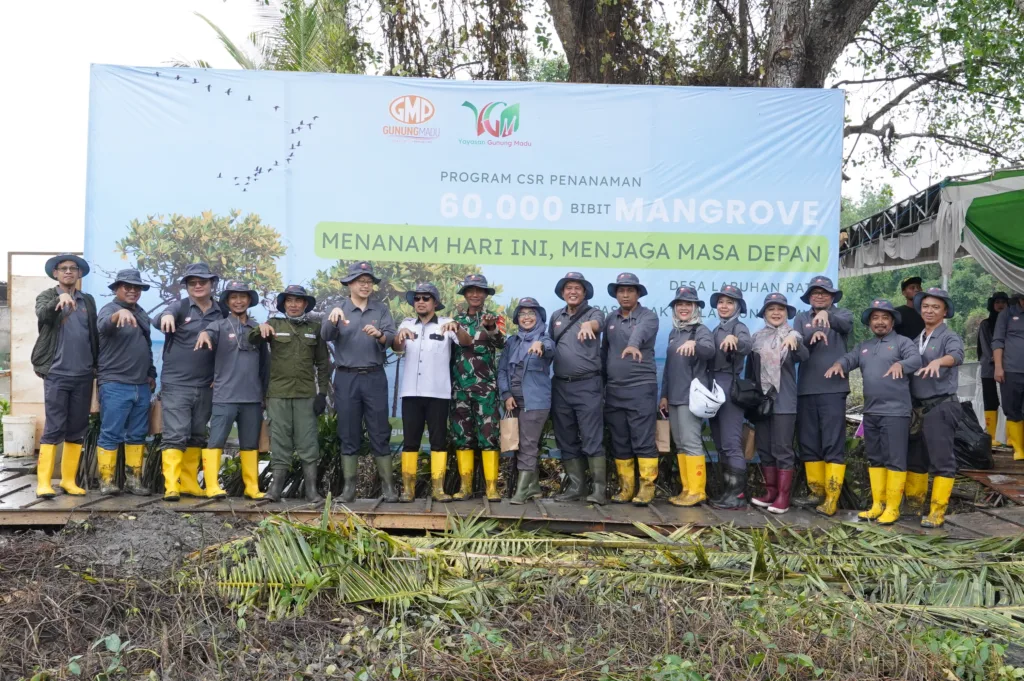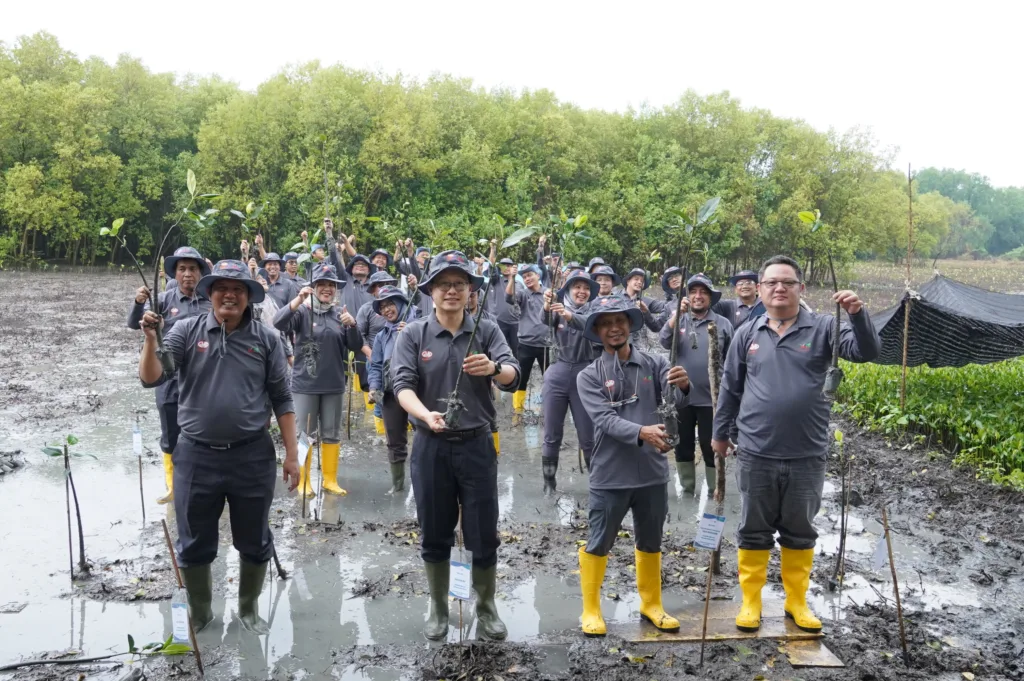
The pier at the end of the embankment in Blukang Hamlet, Labuhan Ratu Village, Pasir Sakti Subdistrict, East Lampung, appeared livelier on Wednesday, February 4, 2026. The board of directors and staff of PT Gunung Madu Plantations (PT GMP) were present to take part in a mangrove planting ceremony. This mangrove planting activity is part of PT GMP’s CSR program commitment to environmental preservation, as well as a series of events commemorating the company’s 50th Anniversary in 2025 through the Gunung Madu Foundation (YGM). The program targets the planting of 60,000 mangrove seedlings in the Blukang coastal area as a response to the threat of abrasion that has eroded the region for years.
The event was attended by PT GMP Director Mr. Chong Seng Wai, department heads, YGM Chairwoman Mrs. Nisa Aryani, representatives from the Lampung Provincial Forestry Office, and members of the Pasir Sakti Subdistrict leadership forum (Muspika). The planting site is located within the protected forest area of Register 15 KPH Gunung Balak, accessible by crossing the Way Sekampung River by boat. This initiative is designed as a long-term program for 2026–2030, with a primary focus on mangrove survival rates. To ensure this, PT Gunung Madu Plantations (GMP), in collaboration with the Gunung Madu Foundation (YGM), has established routine monitoring mechanisms, periodic evaluations, and seedling replacement efforts to ensure optimal mangrove growth.
In addition to serving as a natural barrier against coastal abrasion and sea waves, mangroves are also expected to empower coastal communities through the economic potential of processed mangrove-based products. In his remarks, Mr. Iwan Kurniawan emphasized that this program represents PT GMP’s concrete commitment to implementing sustainable CSR, as well as the application of Environmental, Social, and Governance (ESG) principles.
The mangrove planting efforts along the Blukang coast cannot be separated from the history of environmental degradation that once occurred in the area. Based on satellite imagery, in 2011 the distance from Blukang Hamlet to the shoreline was only 787 meters. Significant mangrove destruction caused by excessive exploitation, including land conversion into shrimp ponds, allowed seawater intrusion to inundate inland areas more freely.
Community awareness began to grow in 2019, when mangrove planting resumed gradually. The impact started to become visible: the distance from the hamlet to the shoreline increased to 1,183 meters. These efforts continued through 2022, with expanded planting areas strengthening the natural mangrove barrier and pushing the shoreline distance to 1,741 meters. By 2024, the increasingly dense mangrove vegetation had extended the distance from the shoreline further to 1,941 meters. The planting of 60,000 mangrove seedlings stands as a symbol of shared commitment to curb abrasion, protect the coast, and safeguard the future of Blukang Hamlet. It is not merely a ceremony, but a long-term environmental investment for the sustainability of East Lampung’s coastal region.